Metal Roof Guidance
Date: May 27, 2026
Overview
All changes must be submitted to ARC using the request form on Modifications and Improvements page.
This document is not an official standard. It is guidance for homeowners considering submitting an ARC request for a metal roof on your main residence. This guidance is not for sheds or detached structures (outbuildings). Per our association’s CCR [Art 10, Sec 29], the ARC can approve roofing materials other than composite shingles. Metal roofs are extremely durable, offer energy efficiency, and can improve home resale value [1, 2, 3]. When considering a metal roof, you should contact your homeowner’s insurance company to confirm replacement coverage and deductible changes for a metal roof installation.
Metal shingles
Metal shingles are also an option. However, many homeowner’s policies do not cover metal shingles as they are a “double over-layment roof”, which means they are installed over your existing shingle roof. Most major insurer carriers are hesitant to cover roofs installed over old roofing because: It hides the condition of the underlying deck (mold/ water damage), adds weight to the house, makes it harder to assess future hail/wind damage. As a suggestion, you should consider checking with your homeowner’s insurance company to confirm if metal shingles are covered by your policy.
Standing seam metal roof
A standing seam metal roof is made with roll pressed sheets of steel - typically 24 gauge. Remember that gauge is the thickness of the metal. The lower the number means the metal sheet is thicker. Standing seam roofs can be welded, attached with metal screws, or ‘snapped’ together at the seam [snap lock].
Standing seam guidance
The ARC will be looking for the following criteria on any ARC metal roof request.
Earth tone colors only - Stay away from colors that reflect light. No galvanized panels or metallic finishes. No red, green, white, or blue metal roofs
At least 24 gauge steel coated panels are preferred to prevent dents - Kynar 500 is a typical coating used by major manufacturers
Straight seam (no T seam or bent seams) with seam height between 1” to 1.5” - see profiles below
Snap lock (instalock) seams - allows for individual panels to be removed if there is damage
Recommend against welded seams - not able to remove a single panel if there is damage.
No screws should be visible on the roof - screws not used to fasten to roof panels
Metal panel must have striations to prevent oil canning and hide dents [4]
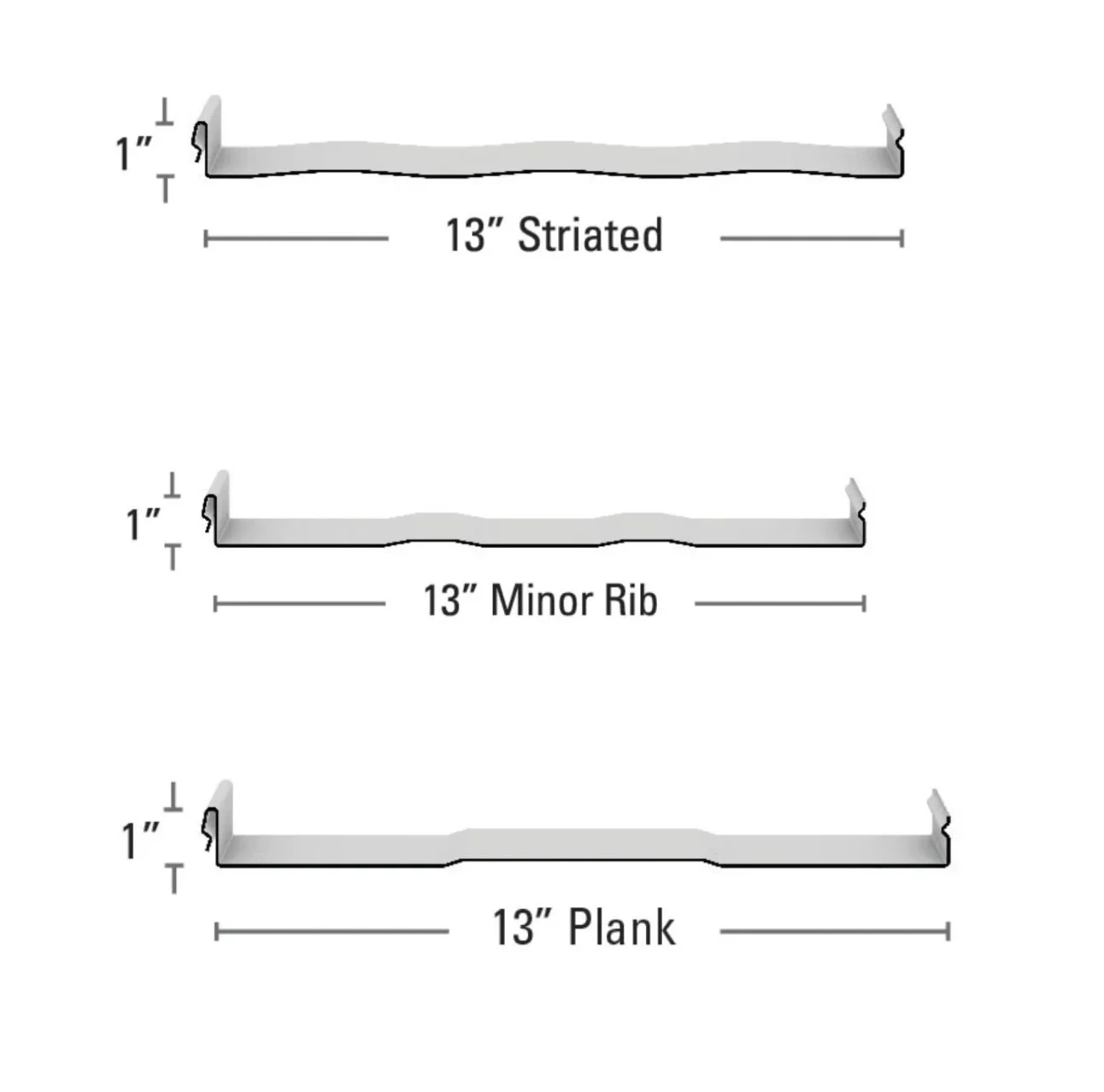
Examples of striated panels with 1” standing seam
Colors
Most manufacturers colors tend to be the same regardless of manufacturer because they all are using Kynar 500 coating [5]. Coated metal roofs tends to resist fading and dents. Berridge and McElroy are 2 metal roof manufacturers that are typically offered in the Austin metro area. See the color swatches for each company in the resources section [6, 7].
Resources
[1] Roofing material durability test - https://www.youtube.com/watch?v=WMEbIxj4kRs
[2] Resale value facts - https://www.angi.com/articles/metal-roofing-facts-and-myths.htm
[3] Energy Efficiency - https://coolroofs.org/resources/what-is-a-cool-roof
[4] Striated roof panels - https://www.berridge.com/oil-canning-in-metal-roof-and-wall-systems
[5] https://www.mcelroymetal.com/paint-substrates/paint/kynar-500
[6] McElroy colors - https://www.mcelroymetal.com/hubfs/Color%20Charts/MM220-0325.pdf
[7] Berridge metal roof colors - https://www.berridge.com/wp-content/uploads/2026/01/Berridge-Color-Card_1-13-2026.pdf
State Farm metal roof facts - https://www.statefarm.com/simple-insights/residence/metal-roof-pros-and-cons
Homeowners face increased difficult insurance landscape - https://communityimpact.com/austin/cedar-park-far-northwest-austin/real-estate/2025/07/16/homeowners-face-increasingly-difficult-insurance-landscape/